Featured

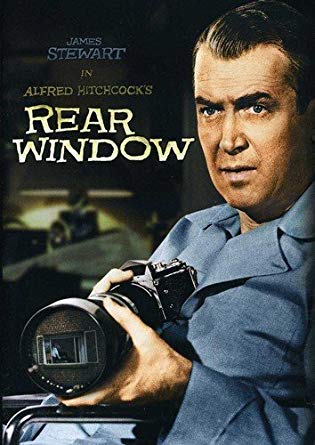
Rear Window- Alfred Hitchcock

The film comments on how we as a society have been evolving from a private sensitive society into an intruded one. Stella and Doyle usually are the only ones that frequently would criticize Jeff’s behavior. In the end, Jeff’s spying did prove his suspicions right, but it doesn’t mean that one has the right to spy on others based on a hunch. I found Jeff creepy for constantly watching his neighbors. Its good that his hunch turned out to be correct but what if it was wrong? Jeff could’ve been sued for defamation or something. It is also extremely dangerous. It is better to leave investigations to the police even if it frustrates us.
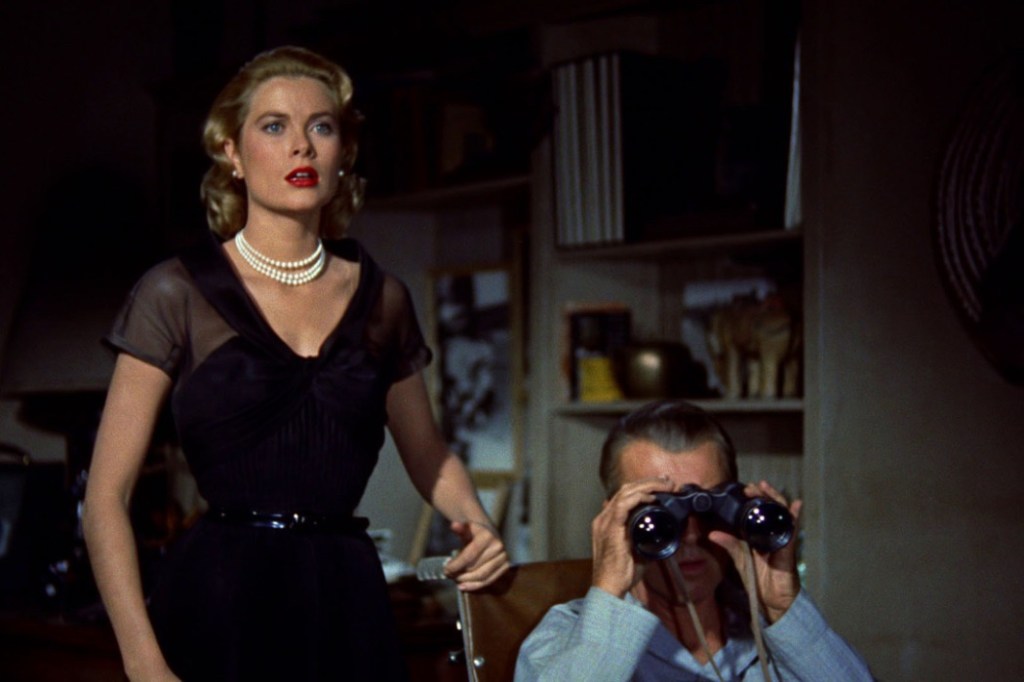
The film comments on how we as a society have been evolving from a private sensitive society into an intruded one. Stella and Doyle usually are the only ones that frequently would criticize Jeff’s behavior. In the end, Jeff’s spying did prove his suspicions right, but it doesn’t mean that one has the right to spy on others based on a hunch. I found Jeff creepy for constantly watching his neighbors. Its good that his hunch turned out to be correct but what if it was wrong? Jeff could’ve been sued for defamation or something. It is also extremely dangerous. It is better to leave investigations to the police even if it frustrates us.

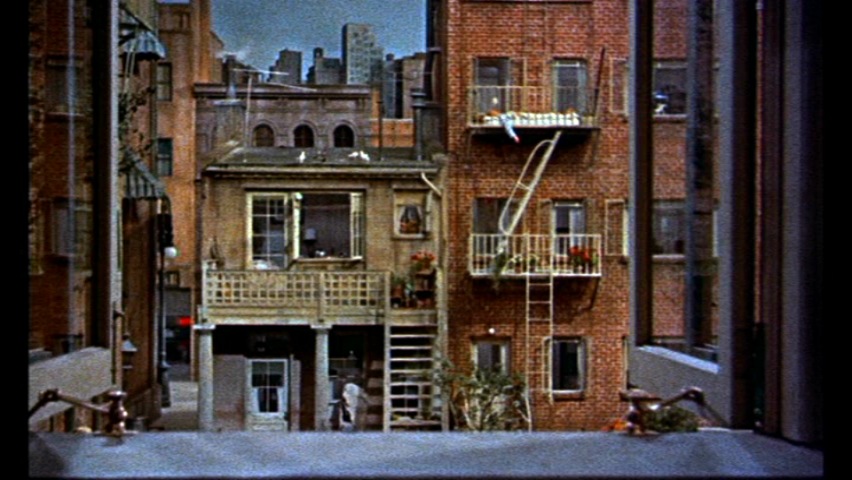
The opening scene of the film is probably one of the most interesting ones I’ve ever seen. It is shot from Jeff’s wandering eyes, creepily staring into his neighbors’ apartments. The weirdest thing he did was to stare into the apartment of the lady that was skimpily dressed in the beginning. I’m not sure if the apartments were intentionally built to look fake like a dollhouse but that’s what it reminded me of. Jeff doesn’t know his neighbors; he doesn’t interact them other than Lars Thorwald. Like a child playing with a doll house, he gave his neighbors, the dolls names like “Miss Torso” and “Miss Lonely hearts”. He would speak about them like if he actually knew them when in reality, he was just watching them.

Another thing I liked about the film is how not only the opening scenes made Jeff look inappropriate but also the viewer. We are seeing the same things too. We are looking into the people’s private homes, seeing parties and fights like if it’s our business. Kind of reminds me how some people become obsessed with the lives of celebrities, thinking how they know them just based what they post online. They are not intruding like Jeff, but both share the same desire to look into the lives of others.

The opening scene of the film is probably one of the most interesting ones I’ve ever seen. It is shot from Jeff’s wandering eyes, creepily staring into his neighbors’ apartments. The weirdest thing he did was to stare into the apartment of the lady that was skimpily dressed in the beginning. I’m not sure if the apartments were intentionally built to look fake like a dollhouse but that’s what it reminded me of. Jeff doesn’t know his neighbors; he doesn’t interact them other than Lars Thorwald. Like a child playing with a doll house, he gave his neighbors, the dolls names like “Miss Torso” and “Miss Lonely hearts”. He would speak about them like if he actually knew them when in reality, he was just watching them.

Another thing I liked about the film is how not only the opening scenes made Jeff look inappropriate but also the viewer. We are seeing the same things too. We are looking into the people’s private homes, seeing parties and fights like if it’s our business. Kind of reminds me how some people become obsessed with the lives of celebrities, thinking how they know them just based what they post online. They are not intruding like Jeff, but both share the same desire to look into the lives of others.
Jordan Peele’s Us

Us Ending Explained And Your Big Questions Answered About Jordan ...

I really enjoyed Jordan Peele’s US. There’s a lot of symbolism and themes in the film. One of the most prominent symbols are rabbits. Rabbits usually symbolize happy things such as luck but the film makes them symbolize experimentation which ties them to the tethered. The tethered were kept confined like the rabbits and now are free. They also had to eat raw rabbit to survive. This might be a reference to how mother rabbits will eat their babies when they are anxious if they think that their survival is not possible. It’s a sad fact but it does happen. It hurt my soul seeing the bunnies locked up in extremely small cages because I have four pet rabbits. Rabbits also appeared in Zora’s shirt in the beginning, are shown as decor pieces and Adelaide had a rabbit plush. There’s also the color red which I can’t figure out other meanings other than violence.

I think that the film’s main theme is to criticize the United States and our society. The film made a point to show that America’s culture is built on materialism and deceit. The peak of success in the United States is measured by wealth and all the fancy things money can buy. The Wilson family is wealthy but not as wealthy as the Tyler family. Gabriel Wilson wants to be like the Tylers and even bought a boat to relate to them. The Tylers look happy but Kitty Tyler isn’t happy. She’s implied to have a drinking problem, is not happy with her face and Josh disregards her concerns over intruders. Her tethered counterpart was also shown to put on makeup but got mad at her reflection. The film also attacked the notion that wealth can protect the rich. Gabe believed at first that they could’ve been safe in the Tyler home even though the Tylers were laying dead around them.

Mulholland Drive

Mulholland Drive by David Lynch is one of the most confusing movies I have ever watched. I knew that when I saw ending explained videos in YouTube, that this film was going to be an interesting film with lots of different takes on it.

A question I have is who is the cowboy man? He opened Diane’s room and told her to wake up.

Also what’s up with the creature?

At first I didn’t understand what was happening and I have seen odd films before. Sometimes I felt that the film was slow in some parts but that might’ve been because I didn’t understand what was happening. After thinking, I made a theory. So, Diane is Betty and Rita is Camilla. Diane began to dream when Camilla was killed. She felt guilty and began to dream where her life was better. Diane was mad that Camilla’s no longer was interested in her. Camilla’s new lover is Adam. In the dream, Adam’s life was ruined by the weird mafia and his wife cheated on him. If the dream was Diane’s version of a better life then it makes sense that her rival’s life was destroyed. She also made Rita (Camilla) very dependent to her. She even had Rita’s memories erased to help her and made herself the only one that can help Rita. Dreams are illogical which explains why Betty almost immediately wanted to help Rita instead if calling the police that there is an intruder in the home. Betty is kind of dumb and naive since she automatically believed what Rita told her. Maybe this is how Diane was when she first arrived to Hollywood. She probably was a nice person and Hollywood destroyed her personality. She became disillusioned and lost in Hollywood.

Shutter Island- Martin Scorsese

Shutter Island is a movie directed by Martin Scorsese. The film’s main lead is actor Leonardo DiCaprio as a mentally troubled patient that has trouble with his identity named Andrew. He suffered from PTSD from World War 2, specifically the killing of surrendered Nazi soldiers which is a war crime. During his investigation of the facilities, he is also plagued by visions of his wife, Dolores and his children as well. This makes him an unreliable protagonist. We don’t know what’s real and what is not because of the details he made up. In the end it was revealed that he is Andrew and has been institutionalized for two years. It was also revealed that his mentally unstable wife drowned their children then he killed her. To cope with his guilt he invented an elaborate story of him being in the island trying to find Rachel.

The ending can be interpreted as him accepting that he murdered his wife and is also responsible for the death of his kids. He willingly tricked Chuck so that he would signal Dr. Crawley that he regressed in order to be lobotomized because his pain is too big.

I really enjoyed the film because of the horror movie vibes it gives off. The opening scenes where Shutter Island is introduced was scary. The island was introduced like if it was going to be the setting of a horror film. The ominous weather and the loud tense music helped add to the vibes. The part in which Teddy was in facility C is nan example of how the film was designed to have horror movie vibes. It reminded me of the video game Outlast because of the asylum setting.

Inglorious Basterds- Quentin Tarantino

Inglourious Basterds - Wikipedia

Inglorious Basterds is a 2009 World War 2 film directed by Quentin Tarantino. It is a film that shows what we expect in a typical World War 2 film. There’s the killing of Nazis, evil Nazis and Americans coming to save Western Europe from Germany.  There is history retelling in the end which shows us what in no doubt many people would’ve like history to have been. The movie reminded me of Once Upon a Time in Hollywood in which there was a retelling of history. In this film, Sharon Tate and her baby survives the Manson attack. Once Upon a Time in Hollywood was made much later but it shows Tarantino’s curiosity about history. The ending shows the brutal yet satisfying death of Hitler and Goebbels.  For figures like them we don’t feel bad for liking when they die but it’s the same reaction the Nazis had when they were watching Frederick’s film. The audience most likely have no problem watching the Basterds scalp Nazis but are probably disturbed by the killing of allies in Frederick’s film.  I think Tarantino’s aim is to make the viewer question their enjoyment of violent films. It might be controversial to say that Tarantino is comparing the audience with the Nazis’ excitement during the premier of the fictional Nation’s Pride.

Cache (Hidden)

Cache by Michael Haneke is categorized as a psychological thriller. Its a film with that touches on a common fear which is being watched by an unknown person. Nobody would like to be stalked and terrorized how the Laurents were. The film opened with a still shot of the Laurent home which I found unnerving. The reason is because it was uncomfortably long especially since it turned out to be from the tape that was sent to them in the beginning of the film. It reminded me of Rear Window but it felt more sinister and it was. It looked like the film was doing to be a straight to the point fillm about the stalking of a family but there were a lot of layers. The tapes gradually started to get more intrusive and the accompanying drawings too.

Georges is a character that represents France’s refusal to take responsibility of the massacre of 1961. Both did not want to publicly acknowledge what they did wrong. Both would have rathered to keep it in the past. The only reason why Georges even remembered Majid was because of the tapes. Before that he was comfortable in his home with a successful career. Georges feels extremely guilty for being the reason why Majid couldn’t be adopted in his family. Majid was betrayed twice by the government for killing his parents and by Georges for denying him the chance of another family.

The scene that impacted me the most was the one with the attempted decapitation of the chicken. I didn’t expect it to be so violent. I just felt bad for the poor chicken during it’s last moments alive.

There is a lot of theories about who was involved in sending the tapes. I don’t think it was Majid. It was probably his son since he is angry at Georges for how his dad suffered because Majid was forced to live in an orphanage without a chance for a proper home and education. In the ending we see the son and Pierrot meeting up afterschool. He probably used Pierrot to send the tapes but then again the ending lingers on the same shot implying that they were being observed by someone else.

Bonnie and Clyde- Arthur Penn

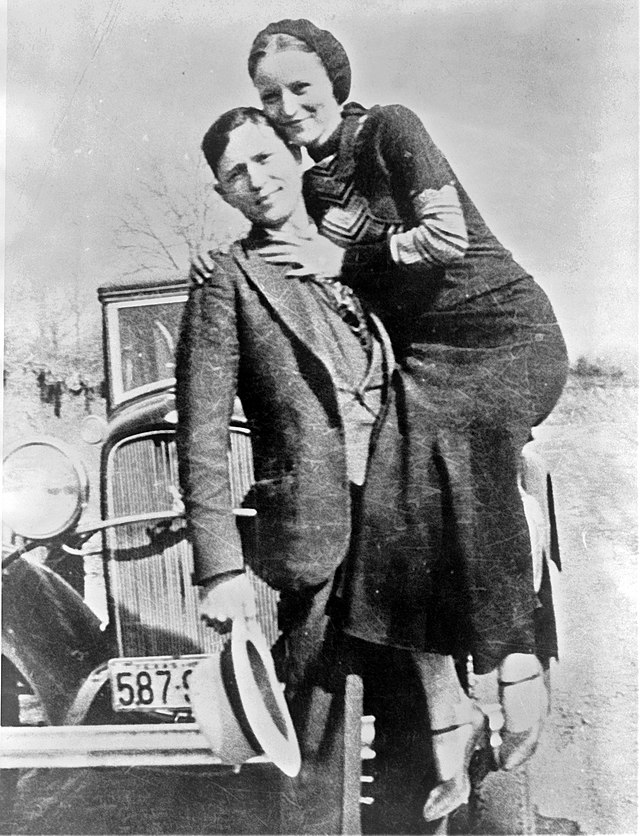
Something new that surprised me was the opening credits of the film. It isn’t like anything we have seen in the previous films. Seeing it felt like an opening to a documentary. The other films like “Casablanca” had openings which had orchestral songs. Other films like “Citizen Kane” had like a title card then started with the opening scene. The opening credits included pictures of Bonnie and Clyde and also some information about them too. Later on, in the film we see both of them recreating famous pictures that real Bonnie and Clyde took. It wasn’t a lot of information but enough to set up a basic backstory. Another thing the film did different which was inspired by the French New Wave is shooting on location. The film wasn’t made to be accepted by Hollywood’s established standards. It sought to break rules with showing the lives of criminals and by not hiding the awful things they did.

I can see how this film was controversial. It’s a biographical film that some may argue glorifies violence and criminals. It broke a lot of conventions of old Hollywood in regard to showing violence and sex. If violence was going to be done in the previous films then it was going to be done off screen or not as bad as we saw in this film. I really wasn’t expecting the first onscreen kill to be as graphic as it was when Clyde shot the banker in the face near the beginning of the film. It is fast and sudden but it quickly established how violent the film was going to be. The ending wasn’t the most brutal thing I’ve seen but probably the most brutal audiences back then saw. Also, weirdly enough the Barrow gang in some instances were protected by the poor. It makes sense since they robbed banks which have displaced many from their homes during the Great Depression.

Bonnie is a very different female character compared to other female characters in the previous films we saw. I think she is a stylish character like Lisa but does not have the typical personality of an old Hollywood female character. Bonnie isn’t “proper” and elegant, but the lack of those characters made her iconic. She does care about her mother, Clyde and her friends but she has no qualms robbing and attacking the police. She didn’t show a lot of remorse when cops ended up being killed. Bonnie is a violent criminal, but she chose to break the mold of a traditional young woman.

To some maybe the ending was inconclusive or abruptly cut. It reminded me of the ending of The Sopranos because both endings scenes were suddenly cut to end, leaving audiences confused. It was a fitting ending because Bonnie and Clyde’s life was suddenly cut short by a rain of bullets.

Make Me Over, Marie Dressler

Marie Dressler was known for her comedy and her unconventional, rule breaking looks. She wasn’t the conventional Hollywood pretty actress but her comedy skits helped her get famous. She also was known for portraying the traditional American hardworking woman. It was interesting to learn about her because she was so different compared to the generic Hollywood manufactured actress. Marie was not bothered about her aging unlike Norma Desmond. She used it as an advantage and continued to make films well beyond what was considered an actress’s prime. Though she was the source of jokes because of her weight and her age, she adamantly defied the expectations of Hollywood and gossip media. Her success story was rare for that time. Usually the fame of an actress would fade away as they no longer could portray a beautiful woman. Both Marie and Norma were from the silent film era but went drastically different routes. Norma tried to revive her career by creating a film starring her. She thought Cecil was still interested in her work and subjected herself to insane treatments that most likely wouldn’t have done anything for her. Hollywood is to blame for what happened to Norma and many forgotten actors and actresses that fell into obscurity.  That’s why Hollywood was bothered by Sunset Boulevard.

Make Me Over, Passing for White

Merle Oberon used skin bleaching products to appear more “marketable”. To be marketable, an actress or actor had to be white. She described as Anglo Indian and did belong to either English or Indian society. Her past is very murky, fathered by an English officer. She had many desirable qualities like high cheek bones but her skin was seen as a drawback. Dark skin was seen as a curse like how the podcast said. This is true in many countries, specifically the ones that were colonized by European empires. The idea of race superiority is an artificial one created by Europeans to justify brutal colonization. The consequences of colonization and race hierarchy is still seen in former colonies such as Mexico where I am from. Rarely in Mexican novelas there are dark Mexicans and success stories like those of Yalitza Aparicio are rare in Mexico. It was crazy to hear how Mexicans said cruel things about her skin color and indigenous background.

To make it big, she had to use whitening makeup and had to adjust her accent. Though, some features like dark eyebrows were described as “disturbing features”. It’s sad how she lied about where she was born and that her mother was her maid. She moved from makeup to skin bleaching products that have mercury which harmed her skin. Even though she appeared white, she was still snubbed from winning awards. Her story is not unique to old Hollywood. Nonwhite actresses and actors are still underrepresented and do not win the same amount of awards like white actors and actresses.

It wasn’t until about the 1960s that she started to stop using bleaching products. Her fake past was starting to unravel. Slowly her story about Tanzania started to be picked apart even though there was conflicting reports. She died at 68 and never publicly acknowledged that she was born in India.

The 400 Blows

Image result for the 400 blows class running

The film is unlike the other films we watched in class in many ways. The most obvious difference is where it was filmed. The other films were filmed on a designed set and this one was filmed on the streets of France with other locations such as the school and the small apartment. It added a more “real” factor to it since the Hollywood classics had deliberately designed sets. The other way is how the camera moves. It is not stationary and it follows Antoine when he runs. The camera is constantly moving with long takes. At times it looks shaky and it gives a found footage film vibe. It looks like the camera is bobbing on water and there’s also aerial like shots which I think we didn’t see in other films. An example of this is when Antoine’s class is jogging and the camera is looking down from a building. Another thing I noticed is the constant use of jump cuts which doesn’t disrupt the continuity of the film.

I enjoyed the film because it feels relatable. The fact that it is a semi-autobiographical film about Francois Truffaut adds an extremely personal touch. Its about the misbehaving actions of a child named Antoine Doinel. The kid is a misbehaving one but one with an sympathetic background. It feels as though everyone except for his school friends are out to get him. The mother acts as though Antoine chooses to act out but she is one of the main reasons for misbehaving. The constant disregard for his feelings and neglect is appalling sometimes. School is supposed to be a safe zone for children but also at school he is berated by the teacher sometimes physically. The part that made me feel bad for Antoine is when he left his home and struggled to live in the streets though it was for a short while. Then when he comeback, the mother acted so out of character and was nice to him. They even had a family night but Antoine continued to suffer throughout the film.

Design a site like this with WordPress.com
Get started